

Not every roofing contractor can offer the same warranty on the same shingle, and the reason comes down to whether the manufacturer trusts them enough to stand behind the installation.

Storm damage demands fast action. An aging roof allows more planning time. Either way, the contractor you choose determines the quality of the result and the warranty that protects it. When you’re evaluating a roofing company, most of what they tell you about themselves, you take on trust.
Certifications are one of the few claims a homeowner can actually check with an outside party, and they tell you something specific about how a crew was trained and what warranty your roof can carry.
To hold a manufacturer certification, a roofing company has to meet standards that go well beyond state licensing, including training, insurance requirements, installation history, and customer satisfaction scores. Not every contractor qualifies, and the ones that do have a financial reason to maintain those standards.
Pure Roofing is an Owens Corning Platinum Preferred Contractor and GAF Certified Plus Residential Roofing Contractor. The requirements behind those partnerships ask more of a company than most homeowners expect, and allow us to offer warranty tiers that most contractors don’t qualify for.
What Manufacturers Require Before Certifying a Roofing Contractor
Manufacturer certifications exist because shingle companies need to know that the contractors installing their products will do it correctly. A warranty is only as strong as the installation behind it, and manufacturers aren’t willing to extend their strongest coverage to companies they haven’t vetted.
The vetting process is more involved than most homeowners realize. Manufacturers like GAF, CertainTeed, and Owens Corning evaluate a contractor’s state licensing, liability and workers’ compensation insurance, financial stability, and time in business before granting any certification. Once certified, the company’s crews are required to complete ongoing training on that manufacturer’s specific installation methods, ventilation requirements, and code compliance. Customer satisfaction scores are monitored, and contractors that fall below the standard risk losing the designation they spent years earning.
That structure is what gives the certification its weight. It’s not a marketing badge. It’s a set of requirements the contractor has to keep meeting, and the consequence of falling short is losing access to the warranty tiers their customers are paying for.
Owens Corning, for example, limits the share of roofers in its Platinum Preferred program, and roofers have to maintain their customer satisfaction scores to keep it.
For CertainTeed’s program, installers have to pass testing on the company’s Shingle Applicator Manual, the document that lays out approved procedures for putting CertainTeed shingles on a roof, and the contractor has to meet insurance and workmanship standards beyond that. Qualifying companies move up through tiers with CertainTeed, and the tier a contractor holds sets which extended warranty it can register.
The training component matters more than most homeowners realize. Different manufacturers have different installation specifications. Where the nail goes into a shingle, and how many nails are used, differ between manufacturers. So does how the starter course is placed, where the ice and water barrier goes at eaves and valleys, and how much intake and exhaust ventilation the manufacturer calls for.
Certification Changes the Warranty Your Roof Can Carry
Shingles come with a material defect warranty no matter who installs them. That warranty covers the shingle delaminating, blistering, splitting, or losing granules in ways that aren’t attributable to normal wear.
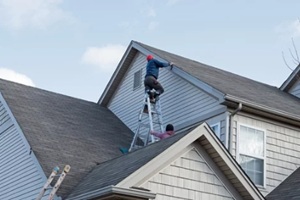
But when a roof fails, the cause is more frequently traceable to how it was installed than to a defect in the product itself.
A roof is more than shingles. It’s also the underlayment, the ice and water barrier at eaves and valleys, the starter strip, the ridge cap, and vents. These are all products designed to be installed together as a complete system, and they’re typically manufactured by the same company.
A contractor certified to install the full set can register one warranty that covers the whole replacement, and in several programs that same document puts the manufacturer behind the workmanship for a set term.
What a Certified Contractor Has at Stake
Manufacturer certification programs put a second set of eyes on the work. Manufacturers review homeowner complaints, and they’ll drop roofers that stop meeting the standard. This gives a contractor who spent years working up to a top-tier designation a real reason to do quality work the first time, and to respond to any calls from a customer promptly.
It is also the difference between a certified local contractor and the crews that turn up in Northern Virginia neighborhoods the week after a bad storm. An operation working a storm three states from home has no manufacturer relationship to protect and no reason to be reachable in the spring. For NOVA homeowners who’ve seen those trucks in their neighborhoods after severe weather, the distinction matters.
A Certification Is Not a License
The Commonwealth of Virginia licenses contractors through the Department of Professional and Occupational Regulation, with the class of license set by the size of the projects a company is authorized to perform.
That license confirms the business met the state’s minimum requirements for financial standing, insurance, and examination. It says nothing about whether anyone on the crew has been trained on the product they’re installing.
Major manufacturers maintain a contractor locator that shows current designations. Both licenses and certifications can lapse. Check both before signing a contract.
What To Ask a Roofing Contractor Before You Hire
Before you hire a roofing company, look at which certifications it holds and with which manufacturers. You want to be sure the company is certified to install the product you’re paying for.
Also ask who is installing the roof. The designation belongs to the business, but labor can be subcontracted out. You want to know whether the certification the company holds applies to the people doing the actual installation.
Ask whether the estimate includes the ventilation and decking work the warranty requires. To qualify for the highest-tier warranties, the entire roofing system has to be installed properly.
Make sure the warranty is in writing. Ask for the specific name of the coverage the contractor intends to register, and ask for a copy of the registration once the job closes.
Talk to a Contractor Who Can Show You the Paperwork
Pure Roofing holds Platinum Preferred status with Owens Corning and 4 Star status with CertainTeed, plus GAF certification on the residential and commercial side. Those credentials allow us to offer warranty tiers that most contractors cannot.
If you are looking at roofing estimates in Northern Virginia, contact Pure Roofing for an inspection. We’ll give you a straight read on the roof’s condition and an estimate that says plainly what warranty the finished roof will carry.